Visa
Visa
Filters
Apply for a Non-Immigrant B Visa in Thailand with Confidence
Are you planning to work, start a business, or expand your company in Thailand? Our expert team provides end-to-end Non-Immigrant B Visa services in Thailand, ensuring a smooth, compliant, and stress-free process from start to finish.
The Non-Immigrant B Visa (Business Visa) is essential for foreigners who wish to legally work or conduct business in Thailand. However, the application process can be complex, requiring precise documentation and coordination with multiple government authorities.
Who Can Apply?
You may apply for a Non-Immigrant B Visa if you:
Have a job offer from a Thai company
Are starting or managing a business in Thailand
Are attending business meetings, conferences, or training
Are investing in a Thai company
Key Requirements for Non-Immigrant B Visa
The application requires documents from both the applicant and the sponsoring company.
Applicant Requirements:
Valid passport with at least 6 months validity
Completed visa application form
Passport-sized photographs
Educational background and work experience
Proof of financial capability
Company Requirements:
Company registration certificate
Company affidavit and business profile
List of shareholders
VAT registration (Phor Por 20)
Tax documents (Por Ngor Dor 1, 3, 53)
Employment contract or invitation letter
Important Considerations
Holding a Non-Immigrant B Visa alone does not permit you to work—a work permit is required.
The sponsoring company must meet Thai legal requirements, including registered capital and employee ratio.
Proper documentation is critical to avoid delays or rejection.
Benefits of a Non-Immigrant B Visa
Legal authorization to work and do business in Thailand
Eligibility for long-term stay (1-year extension)
Ability to apply for a work permit
Option to include dependents under appropriate visa categories
Why Professional Assistance Matters
The Non-Immigrant B Visa process involves coordination with multiple authorities, including embassies, the Department of Employment, and Thai Immigration. Errors in documentation or misunderstanding of requirements can lead to delays or visa refusal.
Working with an experienced visa consultant ensures:
Accurate document preparation
Smooth application process
Compliance with Thai laws and regulations
Faster approval with minimal risk
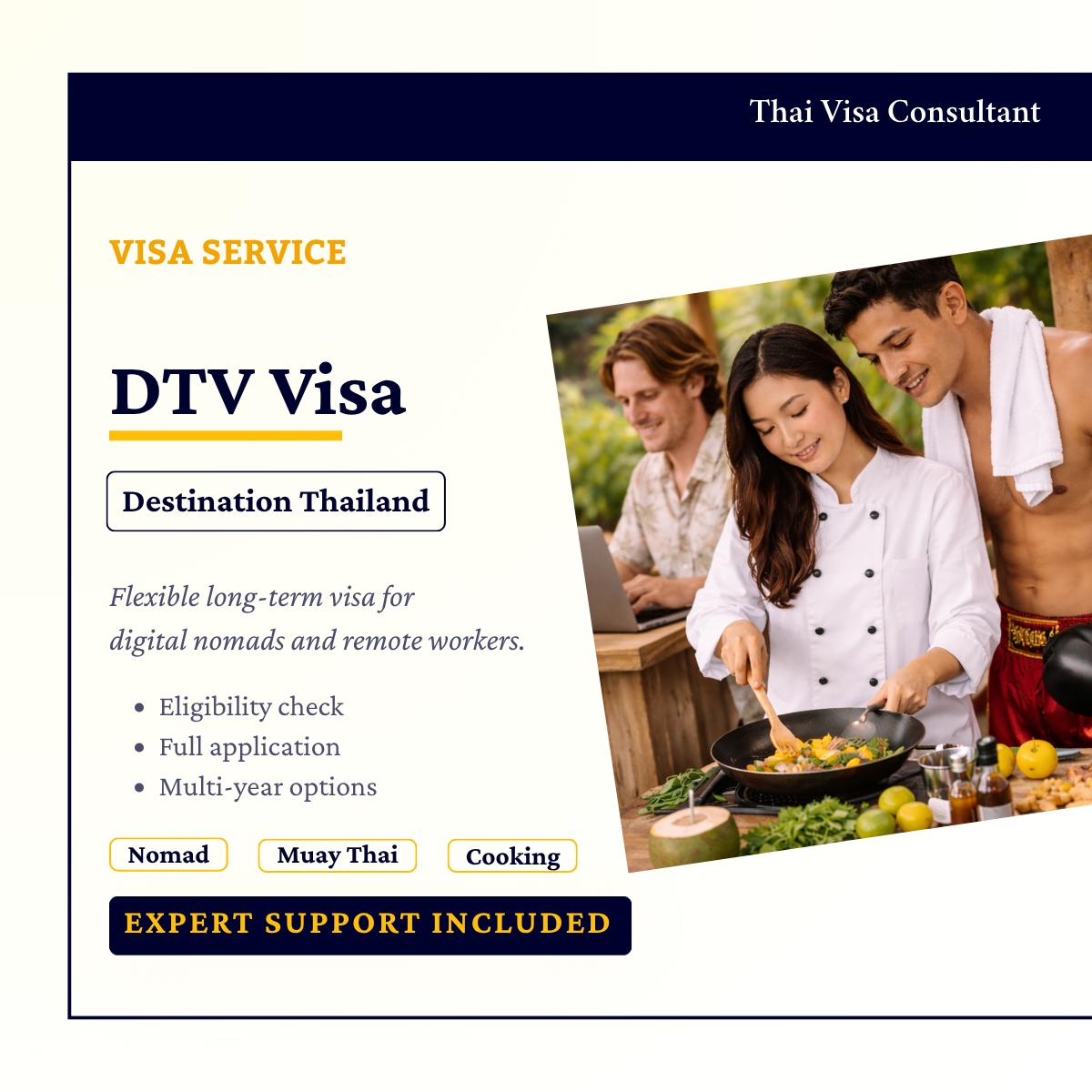
Thailand’s New Destination Visa (DTV): 5-Year Stay for Nomads and Expats Explained
From Freelancing to Muay Thai & Cooking Schools: Beyond a 180-Day Stay to the Freedom of a 5-Year Visa
The Destination Thailand Visa (DTV) is a newly introduced long-term visa designed to attract digital nomads, remote workers, freelancers, and individuals interested in Thailand’s cultural and lifestyle experiences. The visa is part of Thailand’s strategy to promote tourism, cultural exchange, and economic growth by allowing foreigners to stay in the country for extended periods while enjoying flexible lifestyle opportunities.
Unlike traditional tourist visas that only permit short visits, the Destination Thailand Visa provides a more flexible option for foreigners who wish to live in Thailand for longer durations while working remotely or participating in cultural activities.
How the Destination Thailand Visa Is Different from Other Visas
The Destination Thailand Visa stands out because it combines long-term stay privileges with lifestyle and cultural engagement. Many Thai visas require employment with a Thai company or sponsorship from a family member in Thailand. However, the DTV allows applicants to stay in Thailand without working for a Thai employer.
Another major difference is the validity and flexibility of stay. The DTV generally offers multiple entries with a validity of up to 5 years, allowing visa holders to stay in Thailand for extended periods while freely traveling in and out of the country. Each entry typically allows a stay of up to 180 days, with the possibility of extending the stay within Thailand.
In comparison, tourist visas only allow short-term visits, and work visas require sponsorship by a Thai company. The DTV bridges this gap by offering a lifestyle-oriented visa suitable for remote professionals and cultural participants.
Who Can Apply for the Destination Thailand Visa
The Destination Thailand Visa is designed for individuals who wish to stay in Thailand while working remotely or participating in cultural and lifestyle programs. Eligible applicants may include:
Digital nomads and remote workers employed by overseas companies
Freelancers or entrepreneurs with international clients
Individuals interested in Thai culture, sports, or creative activities
Participants in training programs or lifestyle courses in Thailand
Family members (spouse and children) accompanying the main applicant
Requirements for the Destination Thailand Visa
Applicants must meet several requirements to qualify for the DTV. While specific documentation may vary depending on the applicant’s category, the general requirements include:
The applicant must hold a valid passport with sufficient validity.
The applicant must provide proof of financial stability, typically showing at least 500,000 THB in savings or equivalent funds.
The applicant must submit documents supporting their purpose of stay, such as proof of remote employment, freelance work, or participation in cultural programs.
The applicant must provide recent photographs and a completed visa application form.
The applicant must demonstrate sufficient financial means to support themselves during their stay in Thailand.
Applicants applying with family members must provide proof of relationship, such as marriage or birth certificates.
A New Opportunity to Experience Thailand
The Destination Thailand Visa represents a modern approach to long-term stays in Thailand. By combining flexible residency options with cultural engagement and remote work opportunities, the DTV provides a unique pathway for foreigners who want to live, work remotely, and explore Thailand’s rich culture.
With proper preparation and professional guidance, the Destination Thailand Visa can offer an excellent opportunity for individuals seeking a long-term lifestyle in one of Southeast Asia’s most vibrant and welcoming destinations.
Why Thailand is the Best Place for Your Marriage Visa
A 2026 Guide to Non-Immigrant O Requirements, Benefits, and Application Steps
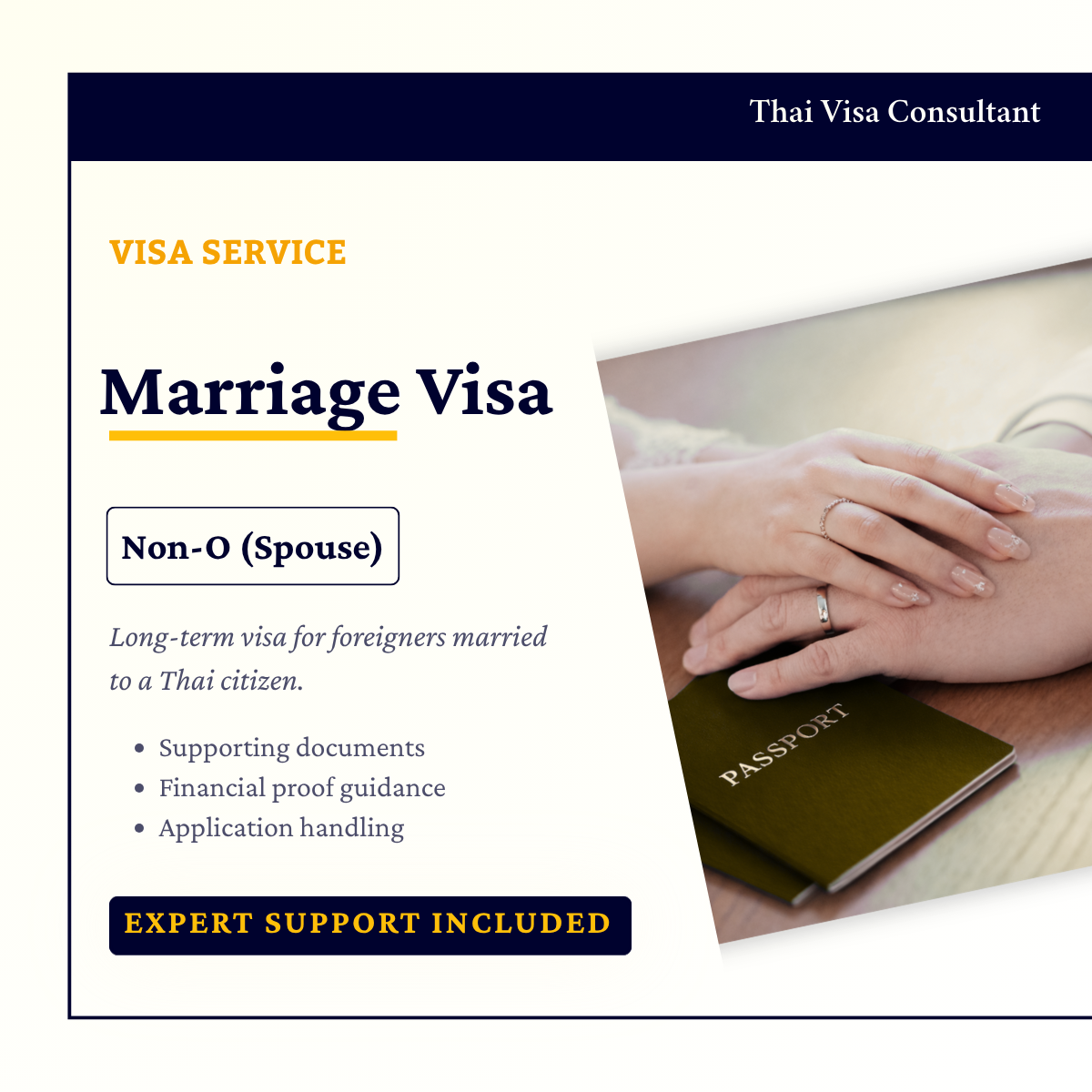
The Thai Marriage Visa, officially known as the Non-Immigrant “O” Visa based on marriage, allows a foreign national who is legally married to a Thai citizen to live in Thailand long-term. This visa is a popular option for foreigners who wish to reside with their spouse and build a life in Thailand while remaining compliant with immigration regulations.
Typically, the visa is initially issued for 90 days. After entering Thailand, the visa holder may apply for a 1-year extension of stay based on marriage with the Thai Immigration Bureau. The extension can be renewed annually as long as the applicant continues to meet the eligibility and financial requirements.
Requirements for a 1-Year Thai Marriage Visa Extension
To apply for a Thai Marriage Visa extension, the applicant must meet the following requirements:
Be legally married to a Thai citizen (marriage registered in Thailand or legally recognized foreign marriage).
Hold a valid Non-Immigrant “O” Visa.
Meet the financial requirements set by Thai immigration.
Reside legally in Thailand and comply with immigration reporting requirements.
Applicants must also provide proof of a genuine marital relationship, including documentation and photos of living together
Thai Marriage Visa: Required Documents
All documents submitted to immigration must be in Thai or officially translated, and both originals and copies must be provided.
Personal Documents
Passport with valid visa stamp
TM.6 arrival/departure card (if issued)
Thai Marriage Certificate (Kor Ror 3) and Marriage Registration (Kor Ror 2)
The Family Registration Certificate (Kor Ror 22), In the case of you are married outside Thailand
Thai spouse’s ID card
Thai spouse’s house registration (Tabien Baan)
Photos of the couple together at their residence (inside and outside the home)
Map showing the location of the residence
Applicants must provide proof of financial stability using one of the following options:
Option 1: Thai Bank Deposit
At least 400,000 THB in a Thai bank account
Funds must be deposited for the required period before application (typically 2 months for the first application)
Option 2: Monthly Income
Minimum 40,000 THB monthly income
This can be proven by:
Income certification from your embassy (if available), or
Bank statements showing monthly transfers of at least 40,000 THB into a Thai bank account.
Why Retire in Thailand?
There are many reasons why Thailand is considered an excellent place to retire. First, the cost of living is significantly lower compared to many Western countries. Retirees can enjoy a comfortable lifestyle with affordable housing, delicious food, and reasonable healthcare costs.
Thailand also offers a high quality of life. Modern hospitals, international-standard medical services, and a well-developed infrastructure make daily life convenient and secure. In addition, Thailand is known for its friendly people, rich culture, and vibrant traditions, which create a welcoming atmosphere for foreign retirees.
Another advantage is the country’s diverse lifestyle options. Whether you prefer peaceful mountain towns, vibrant cities, or tropical beach destinations, Thailand offers a wide range of environments suited to different retirement preferences.
Requirements for Applicants
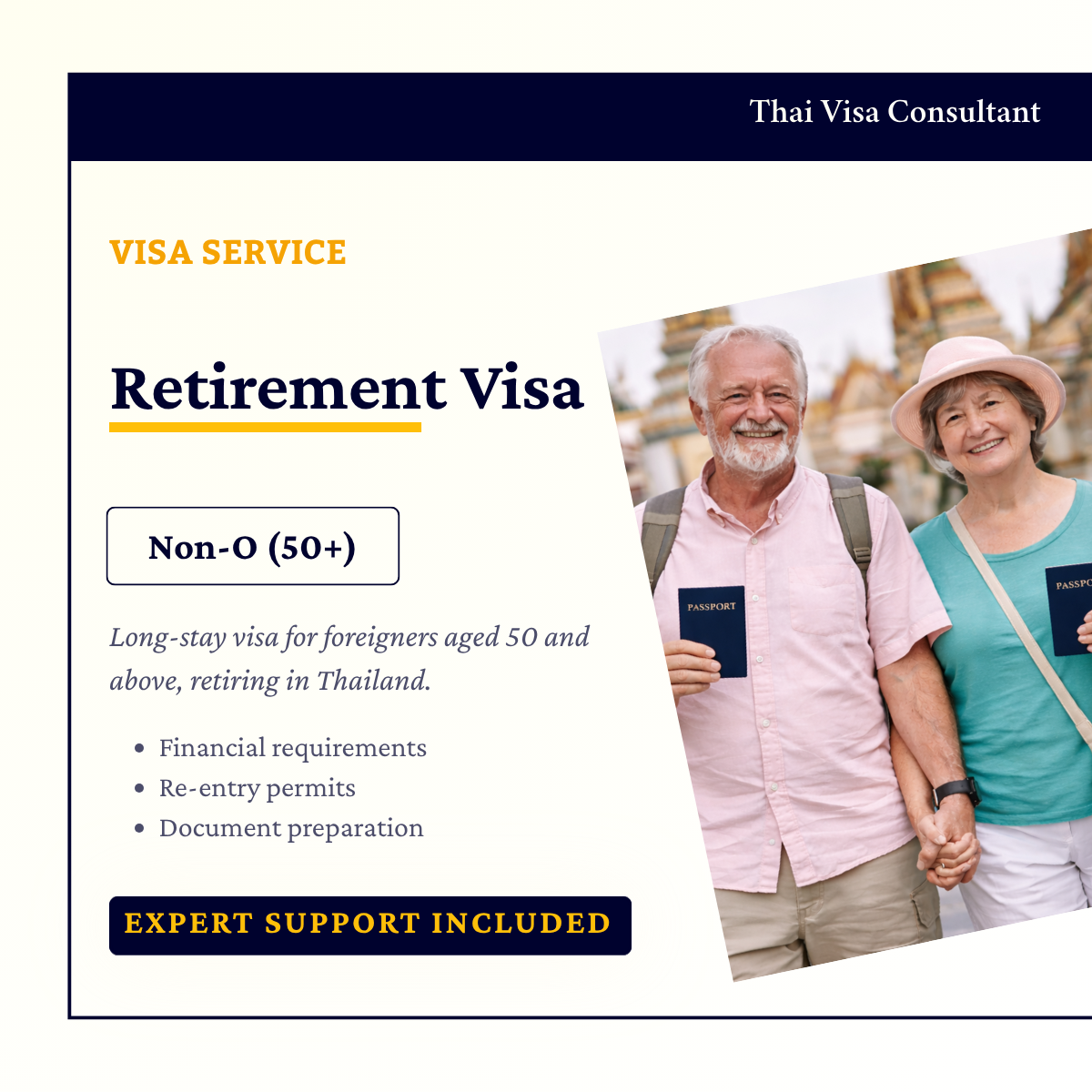
To apply for a Thai Retirement Visa (Non-Immigrant O-A or O), applicants must meet certain qualifications set by Thai immigration authorities.
Generally, the requirements include:
The applicant must be 50 years of age or older.
The applicant must hold a valid passport.
The applicant must meet financial requirements, which typically include:
A Thai bank deposit of 800,000 THB, or
A monthly income/pension of at least 65,000 THB, or
A combination of savings and income that equals 800,000 THB annually.
The applicant must have health insurance (required for some retirement visa types).
The applicant must have no criminal record and must not have prohibited diseases according to Thai regulations.
After entering Thailand with the appropriate visa, retirees can apply for a one-year extension of stay based on retirement, which can be renewed annually as long as the requirements continue to be met.
Best Places to Retire in Thailand
Thailand offers many attractive locations for retirement, depending on lifestyle preferences.
Chiang Mai is a favorite among retirees who prefer a peaceful environment surrounded by mountains and nature. The city offers a relaxed atmosphere, affordable living costs, and excellent healthcare facilities.
Bangkok is ideal for retirees who enjoy city life. The capital offers world-class hospitals, international restaurants, shopping centers, and convenient transportation.
Phuket is popular for those who want to retire near the sea. With beautiful beaches, luxury residences, and international communities, it provides a comfortable lifestyle for retirees who enjoy island living.
Other destinations such as Hua Hin and Pattaya are also well-known retirement hubs due to their seaside lifestyle, international communities, and convenient access to Bangkok.
Professional Assistance with Retirement Visa Applications
Applying for a retirement visa in Thailand involves preparing several documents and meeting immigration requirements. Professional visa consultants can assist retirees throughout the process, including visa application, document preparation, financial guidance, and annual extension support.
With proper planning and the right assistance, retiring in Thailand can be a smooth and rewarding experience, allowing you to enjoy a relaxed and fulfilling lifestyle in one of the most beautiful countries in Southeast Asia. 🌴
No results found
No results match your search. Try removing a few filters.